
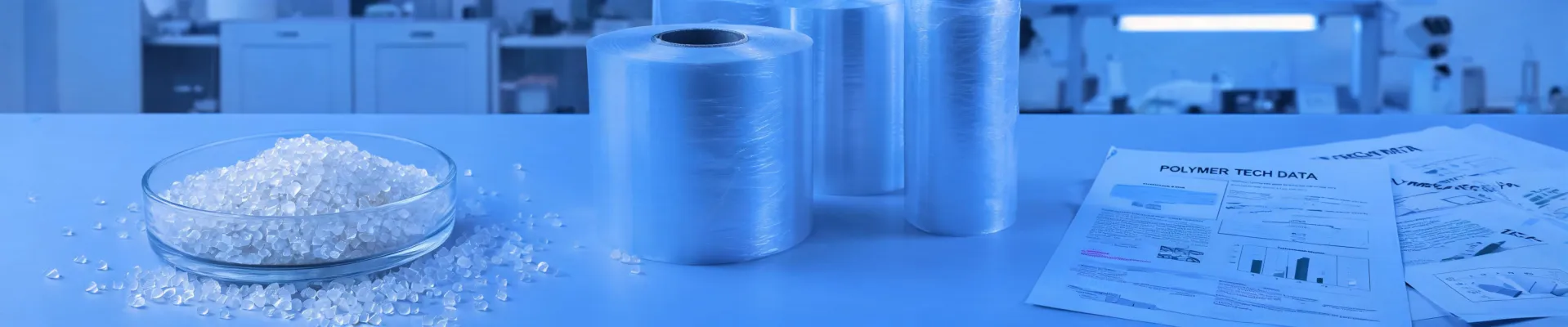
An informed customer asks better questions and makes faster decisions.
I'm an office administrator at a 350-person industrial fabricator. Since 2020, I've managed purchasing worth roughly $1.2 million a year across forty or so vendors. I report to operations and finance. I'm not a chemist. I'm the person who gets called when the wrong material arrives, gets installed, and then fails.
So here's my opinion: you should stop ordering materials by their category names alone. 'Plastic mesh,' 'polypropylene,' 'polyurethane resin'—those words mean almost nothing until you know the grade, the additive package, and the way the part is expected to fail. I'd rather spend ten minutes explaining that to a requester than deal with mismatched expectations after a product is in the field. It's not about making everyone a polymer scientist. It's about making sure the order line actually describes the material that will do the job.
How a 'polypropylene' plastic mesh taught me to check datasheets
When I took over purchasing in 2020, I trusted labels. The first big mistake I inherited was a standard plastic mesh order for a filter cage. The spec said polypropylene. The vendor said polypropylene. The mesh looked like polypropylene. Then a solvent wash made it crack like cheap toffee.
The surprise wasn't the failure. It was why the failure happened. The vendor had switched to a recycled compound with a much lower melt flow rate and no UV package. It cost a few cents per unit less, and nobody told us. The old assumption that 'polypropylene is polypropylene' came from an era when most prime resin behaved similarly. That era is gone.
Now, when I buy polypropylene for a custom mesh or molded part, I don't just write 'plastic mesh.' I write LyondellBasell polypropylene with a published melt flow rate and stabilization package, or a comparable prime grade with a datasheet I can inspect. I also ask for a certificate of analysis before payment. Not because one brand is magic, but because the data sheet gives me a number I can hold the vendor to. That changes the conversation from 'should be fine' to 'it's within spec.'
What 'advanced PE' means when it appears on a purchase order
Last year, an engineer asked for 'advanced PE' on a mesh requisition. I almost asked what that meant. Good thing I did. He meant a high-molecular-weight high-density polyethylene with excellent environmental stress crack resistance and low-temperature impact strength. That is a completely different material from commodity HDPE homopolymer, and it costs more for a reason.
Advanced PE is not a marketing phrase to me. It's a category that includes bimodal HMW-HDPE grades, impact-modified copolymers, and resins with additive packages designed for UV exposure, chemical resistance, or repeated bending. For a plastic mesh that has to hold up outdoors or absorb impact, an advanced PE grade can outperform standard polypropylene. But 'advanced PE' on a purchase order is not a spec. I need the density, the melt flow rate (per ASTM D1238), and the tensile modulus. In that order.
The most frustrating part of material selection is when someone treats those numbers as optional. You'd think a resin grade would be one of the most defined lines on a bill of materials, but it's often the vaguest. The result is a product that shows up exactly the same way... until it doesn't. That's where 'it meets spec' beats 'it looks right.'
Polyurethane resin vs epoxy resin: the question that deserves two questions
Internal teams ask me all the time: 'Polyurethane resin vs epoxy resin—which is better?' My answer is rarely what they expect. It depends on how the part moves and what it has to stick to.
Epoxy resin is rigid. It has strong adhesion to steel, concrete, and many composites, and it handles heat and most chemicals better than most flexible systems. But it can crack under impact, vibration, or substrate movement. Polyurethane resin is tougher and more flexible. It handles abrasion and impact better, but it can be more sensitive to moisture during curing and has a lower thermal ceiling in many formulations.
So I don't compare product names first. I compare failure modes. If I'm coating a concrete floor that gets forklift traffic and cold temperatures, polyurethane resin is usually the better answer because it moves without cracking. If I'm bonding a structural bracket to steel or making a part that has to keep its shape at high temperature, epoxy might win. The product name comes after the application. That's it.
I'm not 100% sure my shortcut works for every plant, but I've watched it cut our rework calls by more than half since 2022. The first question is always: What is the substrate? The second is: What is the failure you can't afford? Then you can argue about chemistry.
Wait, isn't this the supplier's job?
I know what some buyers are thinking: 'I order from the catalog. The vendor should tell me.' That's fair. A good supplier should absolutely push back. But a supplier can only push back if you give them enough information. If you write 'plastic mesh' on a requisition, you will get the most convenient plastic mesh. If you write 'LyondellBasell polypropylene with a melt flow rate of 12, density of 0.905, and tensile modulus within the attached datasheet,' you get a conversation.
That's why I treat material literacy as a purchasing tool, not a technical luxury. I don't need to be a chemist. I need to know enough to ask the right questions. The label on the product is a nickname. The datasheet is the real name. When I buy with the real name, the phone calls stop.
Where I land
The difference between 'polypropylene' and 'LyondellBasell polypropylene' is the difference between a hope and a spec. The difference between 'advanced PE' and a commodity HDPE grade is the difference between a mesh that lasts ten years and one that fails at month eight. The difference between epoxy and polyurethane resin is not a winner; it's a set of trade-offs.
I'd rather spend time explaining material options than dealing with the fallout of a generic order. Help your customer understand the material, and you both win. The informed customer asks better questions, makes faster decisions, and—honestly—makes my job a lot less painful.
So the next time you're about to order plastic mesh or a resin system, stop. Ask one question: What should this material do at the moment it fails? If you can answer that, you're ready to buy. If not, keep asking questions. That's what material knowledge is for.